
E-Smart to launch the 'virtual integrator' – a 'game-changing' airline
This article was originally published by Alex Lennane the Loadstar
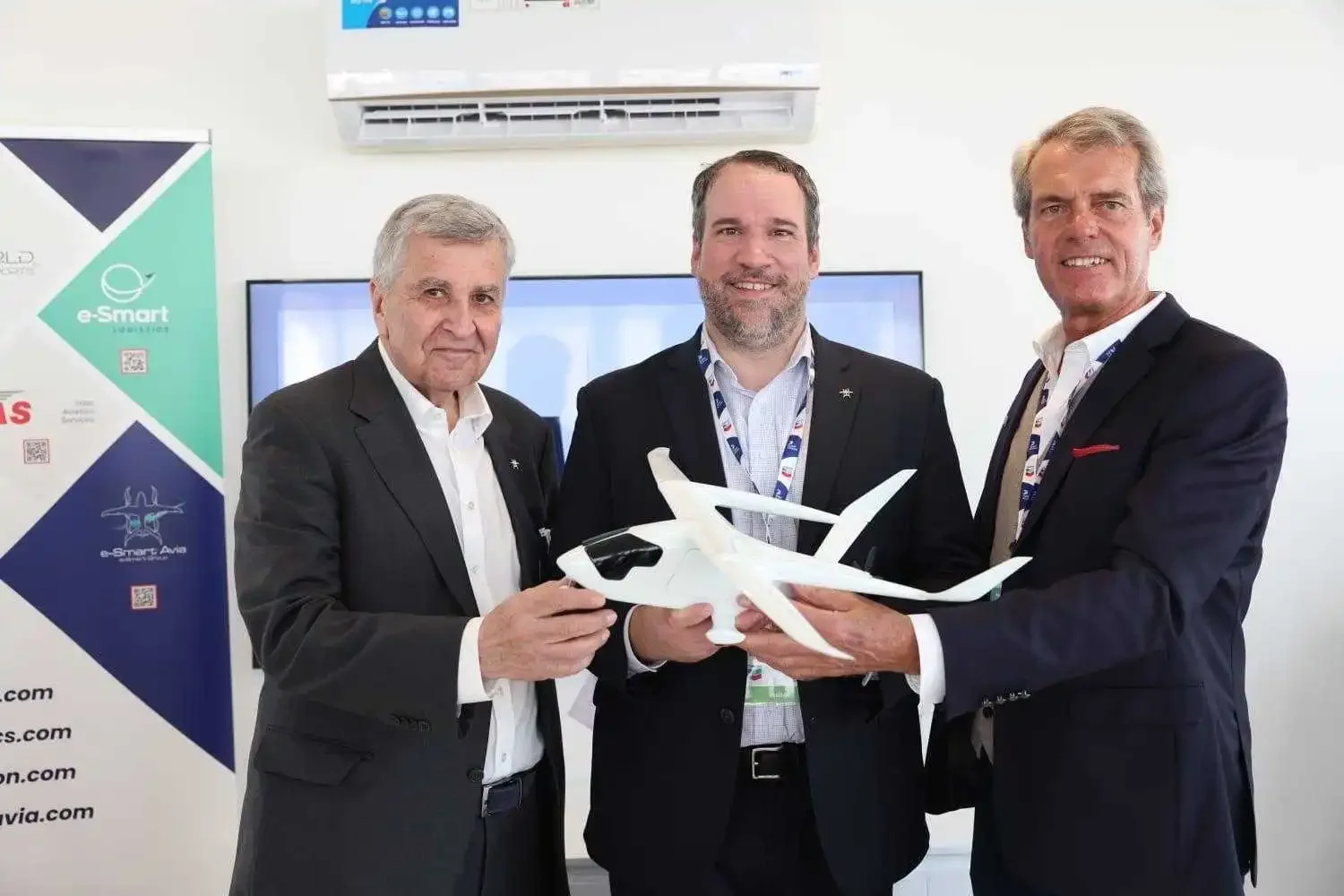
Stan Wraight (SASI), Patrick Buckles (BETA) and Jaques Heeremans (IAS)
A new airline is born: e-Smart Avia. E-Smart Group, the new entity formed by SASI World, IAS Group and e-Smart Logistics, is preparing to launch a new electric aircraft-driven logistics network, arguing that scheduled airlines need new tools to compete with integrators in the fast-growing ecommerce and high-value cargo sectors.
Today at the Dubai Airshow, the company ordered five deposit-backed Beta Technologies’ all-electric ALIA CTOL aircraft, with purchase rights for 15 more.
The plan is to create high-frequency, low-cost regional services that make next-day and express delivery viable on routes where road transport is too slow. The operations would be focused across the EU, UK and the UAE.
Beta’s ALIA CTOL is designed for regional transport, with a 560 kg payload, and 5.6 cu metre cabin interior. Its performance and lower operating costs make it suitable for high-frequency routes connecting major hubs to secondary markets.
“I love the tech so much,” said Stan Wraight, president of SASI World, and co-founder of E-Smart Group.
“It allows a next-day or express product, say, from Dubai International, through DWC, to Abu Dhabi, or routes where trucking is too slow, like Doha or Muscat. Amazon and UPS are huge investors in Beta, the company which shows the interest. It’s a game-changer.”
The group’s strategy is to integrate air, technology, ground operations and digital community systems under one umbrella, creating what it calls a “virtual integrator” model. Executives say this will give scheduled airlines the ability to offer the kind of speed, transparency and reliability shippers expect from integrators, but at lower cost.
“No one else is putting the whole chain together,” said Mr Wraight. “It’s all under one roof.”
The aircraft, costing around $4m each, has become one of the most sought-after platforms in the emerging electric aviation segment. The company already has a 600-aircraft backlog and certification is expected in the second half of 2026, with E-Smart’s deliveries slated for Q1 27.
Its operating economics are a major selling point, said Mr Wraight.
“With a full payload over 249 nautical miles, the charging cost is $17 to $30 per hour ,depending on local charges, Fuel for a Cessna on the same route would be about $700.”
Charging takes 45 minutes, and the aircraft’s simple design significantly reduces maintenance overheads.
“It’s very simple engineering – just two components in the engines for example. You can change the engine in three hours and keep the maintenance kit in a tool bag the size of a suitcase.”
Training for pilots is also easy and the airframe is currently rated for 40,000 cycles, making it suitable for high-frequency ecommerce operations.
E-Smart is still evaluating where to base its first air operator certificate, said Mr Wraight, adding: “Interested parties are in the UK, EU – Amsterdam or Paris – and the UAE.”
With E-Smart’s scheduled airlines, e-Commerce technology provided by Kale Logistics through its AVLOG systems, any hub part of one of Kale’s airport communities, for example, could attract new clients, or better serve existing ones, said the company.
The project has been self-financed to date, though E-Smart is considering additional capital options.
“We may look at a sale-and-leaseback on the aircraft, or a strategic investor,” said Mr Wraight.
E-Smart claims that combining electric aircraft with smart-airport tools, AI-driven community systems, and unified handling processes will allow airlines to offer cost-competitive express products in markets long dominated by integrators when they embark as clients.
Next-day deliveries for ecommerce, life sciences, automotive, and aerospace spare parts are expected to be among the earliest applications.
With pressure mounting for cleaner, faster regional air networks, E-Smart believes electric aviation will give its airline partners a decisive advantage.
“Airlines want to compete with products for high-value verticals,” said Mr Wraight. “This gives them the tools to finally do it.”